

The world beyond my mind
Why healing alone will never make us whole

Lately, I’ve been noticing how easily my thoughts turn inward.
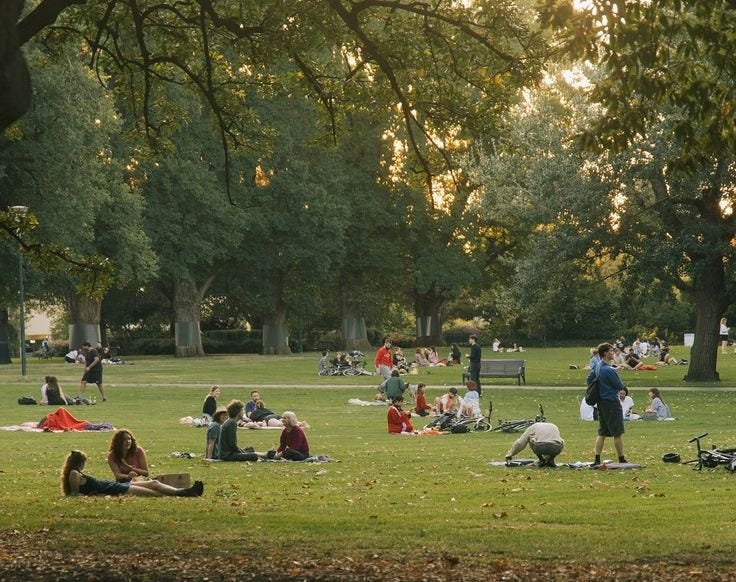
A few blocks from my apartment is a park that sits atop an old landfill. Before writing became my daily rhythm, I spent most mornings there, walking slow laps beneath the trees.
The clocks have gone back, and the evenings stretch longer now. Dogs tear through the grass, their joy unrestrained, while my mind loops through familiar questions that never seem to end. I watch the people around me—runners with their headphones in, friends sharing a bottle of wine on the hill—and feel close to them and far away.
It’s a strange thing, to be so preoccupied with the contents of one’s own mind. I spend far too much time thinking about myself, not out of vanity, but out of habit. I have a deep need to understand what feels difficult, as if clarity could save me from discomfort. But that search often becomes its own trap. Reflection turns to rumination. The impulse to make sense of myself leaves little room to simply be.
Sometimes I imagine what it would be like to live without an inner monologue. To hear silence where there is constant chatter. Would it feel peaceful or empty? Would I find space in that quiet, or would I miss myself in it?
We live in a culture that rewards inwardness. The world tells us to look within for every solution and to fix ourselves before reaching out to anyone else. Self-reliance has become a virtue. So has self-analysis. Healing is framed as an individual task that we must master alone. Yet I’m beginning to wonder if this constant self-focus has led us away from what actually makes us whole.
German humanistic philosopher and psychologist Erich Fromm once suggested that a society can be sick in ways that seem healthy. We mistake functionality for wellness and productivity for sanity. In a culture that prizes efficiency over empathy, self-sufficiency begins to appear as a sign of strength. It often feels safer to manage our emotions privately than to risk being seen in our struggle. Pain starts to seem like a personal defect rather than what it usually is: a response to disconnection.
In a recent interview, writer Johann Hari said that anxiety and depression are not signs of a broken machine but of unmet human needs. He explained that while our culture has advanced in many ways, it has become increasingly poor at meeting our deeper psychological needs. We need belonging, purpose, and recognition as much as we need food and shelter. When those needs go unmet, suffering becomes a natural response rather than a malfunction.
It’s no wonder many of us turn inward, hoping that self-improvement will fill the gaps our culture leaves behind. For years, I thought healing meant getting better at managing myself. Psychologist Abraham Maslow saw it differently. He believed self-actualisation was not a destination but a process of becoming less guarded, more open to beauty, and more present to life as it unfolds. Fulfilment, according to Maslow, comes from expanding our capacity to feel, not from perfecting who we are.
Maslow’s vision reminds me that growth is not something we can do alone. We grow in moments that draw us out of ourselves and into something shared. The self cannot develop in solitude because who we are is shaped in relation to others. Healing depends on connection. We are not meant to carry our pain alone or to make sense of it in isolation.
When I look back, the moments that softened me were never moments of willpower. They were moments of connection: sitting across from a friend who understood, working alongside people who cared, being met with gentleness instead of advice. What helps us heal is not isolation but shared humanity. Not perfection but presence.
Perhaps that is what Maslow meant when he wrote that identity is only a step toward transcendence. We build a sense of self not to polish it endlessly but to eventually move beyond its edges. We become ourselves through one another.
I have been thinking about this recently as I return to the park in the evenings. The light falls differently now, softer and easier to stand in. Dogs still race through the grass, and the air hums with conversation.
When my thoughts inevitably wander, I try not to let them take over. I watch the people around me and feel the air move between us. In those moments, I remember that the world is so much bigger than the noise in my mind.
Thank you for reading. It truly means the world to me! 💌
I didn't know it but I needed this today. "The impulse to make sense of myself leaves little room to simply be." - this is going right iat the top of my motivations/affirmations list! Thank you for sharing this wisdom ♡